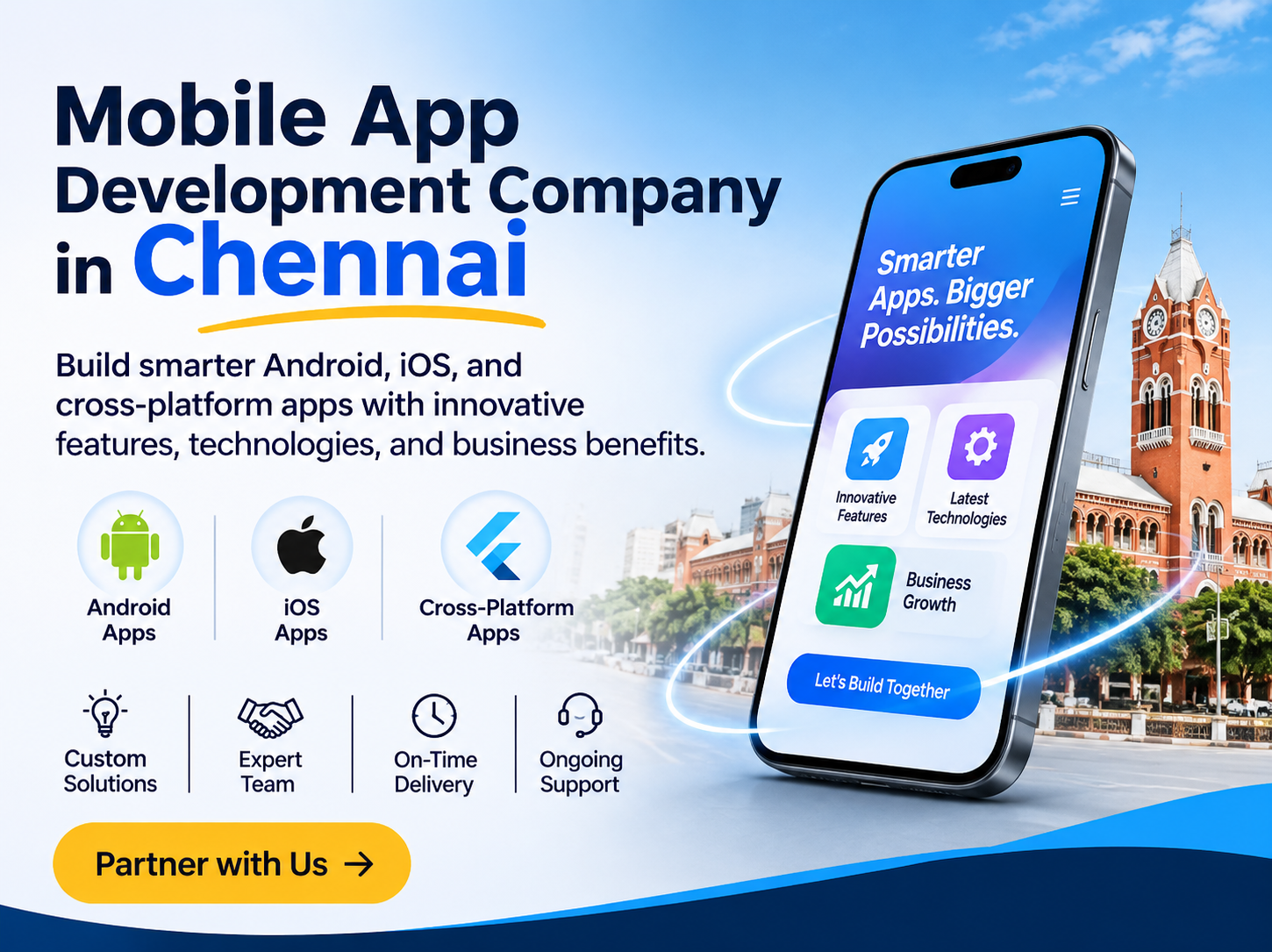

Introduction
Mobile technology has changed the way businesses communicate with customers, manage operations, and deliver services. From online shopping and digital payments to healthcare platforms and business management systems, mobile applications have become an important part of everyday life. As customer expectations continue to grow, businesses need digital solutions that offer convenience, speed, and reliability.
Choosing the right Mobile App Development Company in Chennai can help businesses turn innovative ideas into practical mobile applications. Whether a company wants to launch a new digital product, improve customer engagement, or simplify internal operations, a well-developed mobile application can make a significant difference.
Chennai has developed into an important technology and software development hub, with businesses investing in mobile solutions to remain competitive. However, creating a successful application involves more than writing code. It requires strategic planning, user-focused design, advanced technology, and continuous improvement.
Why Mobile Applications Are Important for Modern Businesses
Customers increasingly expect businesses to provide information and services through convenient digital platforms. Mobile applications help companies meet these expectations while building stronger customer relationships.
Unlike traditional communication channels, mobile apps allow businesses to connect with customers directly through notifications, personalised services, and interactive features.
Here are some important business benefits of mobile applications.
Improved Customer Engagement
Mobile applications create a direct communication channel between businesses and their customers. Companies can share updates, introduce new products, send promotional notifications, and provide customer support without depending entirely on third-party platforms.
Additionally, personalised recommendations and customised features can encourage customers to interact with the application regularly.
Better Business Efficiency
Businesses can use mobile applications to automate everyday activities, including appointment scheduling, order processing, employee management, inventory tracking, and customer enquiries.
As a result, employees can reduce repetitive manual work and focus on important business responsibilities.
Stronger Brand Visibility
A mobile application gives businesses another opportunity to establish their brand presence. A professional interface, consistent branding, and useful features help create a recognisable digital identity.
Moreover, customers can access business services directly from their smartphones whenever they need them.
How a Professional Mobile App Development Company Creates Better Digital Experiences
Developing a successful mobile application requires a structured approach. Every stage, from understanding business requirements to launching the application, contributes to its performance and usability.
Understanding Business Requirements
The first step involves identifying the purpose of the application. Developers work with businesses to understand their target audience, operational challenges, expected features, and long-term objectives.
For example, an e-commerce company may require product catalogues, shopping carts, payment gateways, and order tracking. Meanwhile, a healthcare organisation may need appointment booking, patient records, and consultation management.
Clearly defined requirements help establish the right development direction.
User Interface and User Experience Design
An application's design directly influences how customers interact with it. Complicated navigation, slow-loading screens, and confusing layouts can discourage users from continuing.
Therefore, developers focus on creating clean interfaces, simple navigation, readable content, and consistent design elements.
An effective user experience should allow customers to complete important activities with minimal effort.
Choosing the Right Development Technology
Technology selection depends on the application's purpose, performance requirements, available budget, and target devices.
Common mobile app development technologies include:
- Flutter: Supports cross-platform development using a shared codebase.
- React Native: Helps developers build applications for Android and iOS using React and JavaScript or TypeScript.
- Swift: Used for native iOS application development.
- Kotlin: Widely used for modern Android application development.
Selecting suitable technologies helps businesses balance development costs, performance, scalability, and maintenance requirements.
Development, Testing, and Deployment
Once the design and technology are finalised, developers begin building the application's functionality.
The development process may include user authentication, database integration, API connections, payment systems, notifications, and administrative dashboards.
However, development alone does not guarantee quality. Applications must undergo functional, performance, security, and device compatibility testing before release.
Finally, developers prepare the application for publishing on the Google Play Store and Apple App Store, following their respective submission requirements.
Essential Features Every Modern Mobile Application Should Include
A successful mobile application should offer features that solve genuine customer problems rather than simply adding unnecessary functionality.
Some important features include:
- Simple Registration and Login: Provide convenient account access with appropriate authentication options.
- Secure Payment Integration: Support reliable payment processing for applications involving online transactions.
- Push Notifications: Share important updates, offers, reminders, and service information.
- User-Friendly Navigation: Help customers access essential features without confusion.
- API Integration: Connect the application with websites, CRM platforms, payment systems, and other business software.
- Data Security: Protect customer information through suitable security measures and access controls.
- Performance Optimisation: Maintain responsive screens, efficient resource usage, and reliable application performance.
- Analytics Integration: Understand user behaviour and identify opportunities for improvement.
Businesses should prioritise features according to customer expectations and operational requirements.
Native vs Cross-Platform App Development: Which Is Better?
One of the most common decisions businesses face is choosing between native and cross-platform application development.
Both approaches offer different advantages, and the right option depends on the project requirements.
| Comparison | Native Development | Cross-Platform Development |
| Technology | Swift, Kotlin | Flutter, React Native |
| Platforms | Separate development for each platform | Shared codebase for multiple platforms |
| Performance | Direct access to platform capabilities | Performance depends on implementation |
| Development Cost | Can require a higher investment | Can reduce duplicated development work |
| Maintenance | Separate platform codebases | Shared codebase simplifies many updates |
Native development is suitable for applications requiring platform-specific capabilities, intensive processing, or specialised device integration.
On the other hand, cross-platform development can be a practical choice for businesses that want to launch on Android and iOS while sharing much of the application code.
A professional development team can evaluate these requirements before recommending an approach.
Industries Benefiting from Mobile App Development in Chennai
Mobile applications are transforming business operations across several industries.
Retail and E-commerce: Shopping applications allow customers to browse products, compare prices, make payments, and track deliveries.
Healthcare: Healthcare applications support appointment scheduling, digital consultations, patient communication, and access to medical information.
Education: Educational platforms provide online courses, learning materials, assessments, and student progress tracking.
Real Estate: Property applications help users explore listings, schedule property visits, and communicate with agents.
Food and Hospitality: Restaurant applications simplify table reservations, food ordering, delivery tracking, and customer feedback.
Logistics: Logistics applications support shipment tracking, delivery management, route planning, and operational monitoring.
These applications demonstrate how mobile technology can address industry-specific challenges and improve customer experiences.
How to Choose the Right Mobile App Development Company in Chennai
Selecting a development partner is an important business decision. A reliable company should understand both technology and business objectives.
Consider the following factors before making a decision:
1. Development Experience: Review the company's experience in developing Android, iOS, and cross-platform applications.
2. Portfolio and Previous Projects: Examine completed applications to understand the team's design quality, technical capabilities, and industry experience.
3. Technology Knowledge: Ensure the development team works with suitable frameworks, programming languages, databases, and integration tools.
4. Communication and Project Management: Choose a team that provides clear project updates, realistic timelines, and transparent communication.
5. Security and Testing: Confirm that the company follows appropriate security practices and performs detailed application testing.
6. Post-Launch Support: Application development does not end after publishing. Regular updates, bug fixes, performance monitoring, and compatibility improvements are essential.
Evaluating these factors helps businesses identify a development partner that can support their requirements beyond the initial launch.
Frequently Asked Questions
1. How much does mobile app development cost in Chennai?
The cost depends on application complexity, design requirements, platform selection, integrations, and development time. A basic application generally requires less investment than a feature-rich platform with payment systems, dashboards, and third-party integrations.
2. How long does it take to develop a mobile application?
A basic application may take a few weeks, while a complex business application can require several months. The timeline depends on functionality, design approval, testing, and project requirements.
3. Should I develop an Android or iOS application first?
The decision depends on your target audience, business model, and budget. If your customers use both platforms, cross-platform development may offer a practical starting point.
4. Is Flutter suitable for business mobile applications?
Yes. Flutter supports Android and iOS development through a shared codebase. It offers flexible UI development and can help reduce duplicated development work.
5. Does a mobile application require regular maintenance?
Yes. Regular maintenance helps address technical issues, security updates, operating system changes, and performance improvements. It also allows businesses to introduce new features based on customer feedback.
Conclusion
Mobile applications have become valuable tools for businesses that want to improve customer engagement, simplify operations, and expand their digital presence. However, achieving these benefits requires careful planning, suitable technology, user-focused design, and reliable development practices.
Choosing an experienced Mobile App Development Company in Chennai can help businesses transform their ideas into functional digital products. From initial consultation and UI/UX design to development, testing, and ongoing maintenance, the right development partner can support every stage of the journey.
As digital expectations continue to evolve, businesses that invest in useful, secure, and scalable mobile applications will be better positioned to serve their customers and adapt to changing market requirements.

Read latest blogs
4 days ago
Mobile App Develop ...
Discover how a mobile app development company in Chennai builds smarter Android, iOS, and cr ...
READ MORE 1 week ago
Custom ERP and Mob ...
Should your business build a custom ERP system or a mobile app first? Use examples from sale ...
READ MORE 3 weeks ago
Best Mobile App De ...
Looking for the best mobile app development company in Chennai? Build fast, secure, and scal ...
READ MOREIndustries We Serve
We build custom software solutions across 15+ industries — tailored to your sector's unique workflows, regulations, and goals. Explore how we can help your business grow.
Healthcare
Education
Real Estate
Retail & E-commerce
Manufacturing
Logistics
Finance & Banking
Travel & Hospitality
Food & Restaurant
Automotive
EV Charging
IT
Media & Entertainment
Government
Non-Profit & NGO
Have any Inquiries?
If you have any inquiries, feel free to contact us. Our Expert team will get back to you Shortly.